

I'm sure you've noticed in the last year how basically every tech tool known to man has scrambled to roll out a SUPER SPECIAL AI version of whatever they offer.
At the same time, these companies are laying off massive parts of their workforce. (Tell me why I haven't been able to talk to a human in Circle support for over a year; and also why I hate Circle AI.)

Most of these platforms are also experiencing a variety of problems, lack humans to help, and have to, once again, scramble to fix them. All the while, they're not only losing trust with their customer bases, but making them incredibly aggravated. This story is playing out on a larger scale as well—airlines, banks, you name it.
This isn't an email about AI. It's an email about being a tortoise. In a world (of robots) pressuring you to be a hare.
Call it descending from a lineage of lawyers, an Earth-dominant natal chart, or over a decade of entrepreneurship—when everyone's bum-rushing towards something, I know that's my cue to sit back and observe.
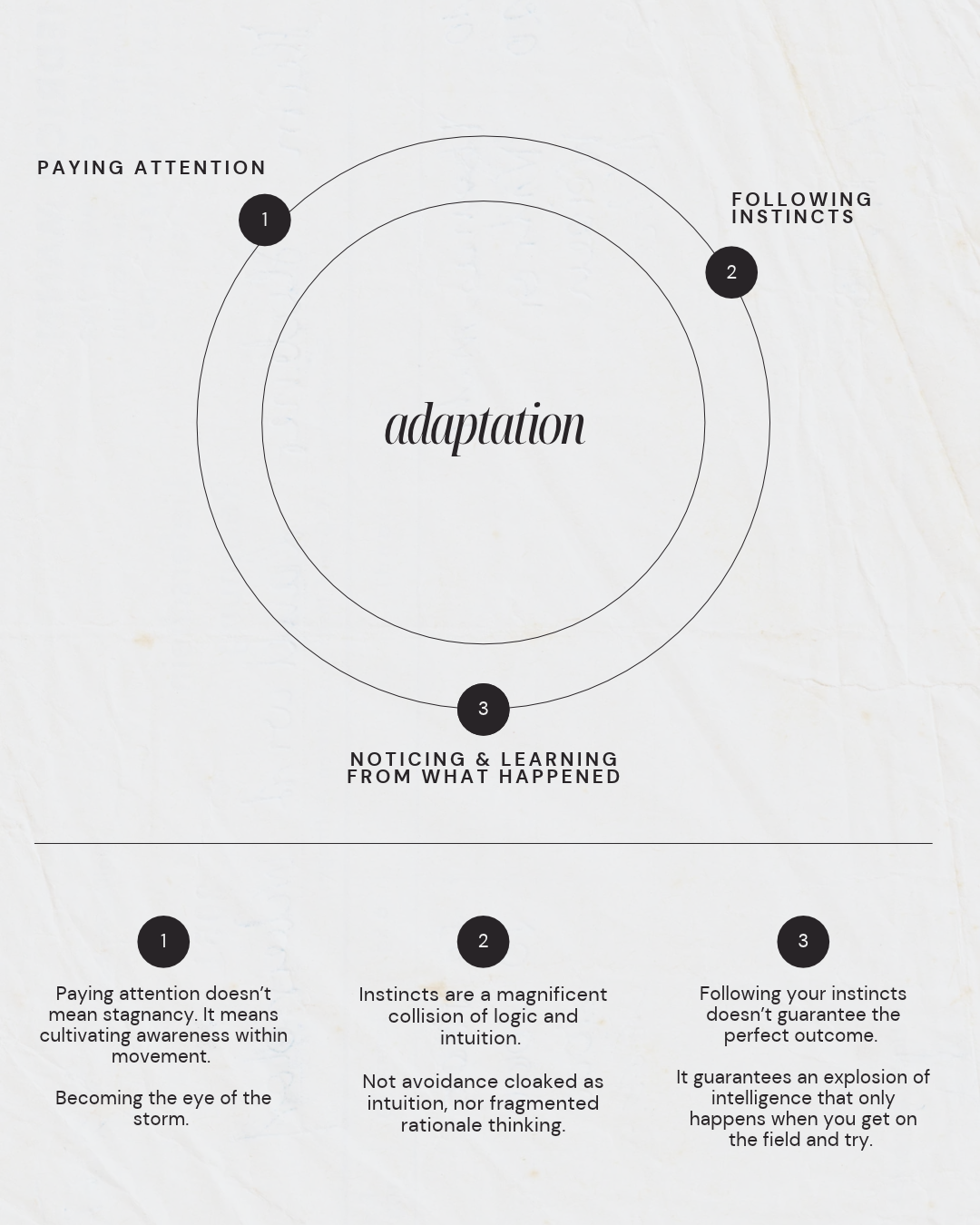
Entrepreneurs are told we need to be adaptable. But adaptability isn't the same thing as rushing.
I've found it naturally emerges from staying centered and paying attention. If not, you'll be carried by the winds of every new trend and call it adapting.
From this place, adapting —or trying something new—becomes a valuable asset, regardless of outcome. Because when you're rushing, and sh*t hits the fan (which it always will), all you know is you rushed.
credit: me
Nick Saban, largely known as the greatest college football coach of all time (and one of my business coaches, as it were)—is old school.
Decades into his coaching career, a different style of offense emerged, and what had always worked for him no longer did.
(For anyone who cares, it was the switch from his conservative, pro-style, run-heavy offense to a fast-paced spread, no-huddle, and run-pass option (RPO) attack during the mid-2010s.)
I've paid very close attention to this part of his story.
He was doing things the way he knew how to, and paying attention. His team played a game against a school that had adopted the new style, and he saw, clear as day, that their current capabilities weren't a match for it.
He did his due diligence, brought in a new offensive coordinator who was considered an innovator of this style, and got to work transitioning his team.
There was no desperation; no pride; no rush. Just calm, clear perception. Because of this (in my humble opinion), he both picked up on it earlier than other teams and was able to transition his team to the new offense methodically.
We can't talk about adaptation without talking about what precedes it—innovation.
In 2013, at the height of complex mass-marketed album rollouts, Beyoncé released her self-titled fifth studio album (Beyoncé) at midnight on iTunes with no prior announcement, promotional singles, or traditional marketing campaign.
This was a meteoric moment that changed the music landscape forever. All built on paying attention.
Beyoncé had done the cookie-cutter rollouts; she'd played the 'release singles because nobody listens to albums anymore' game; and she'd repeatedly had songs leaked before an album was complete.
All leading to the conviction that, "She did not want her album judged off of one three-and-a-half-minute song. She wanted it to be seen as a complete body of work."
Thus, creating the innovative album release.
Over the last ten years I've witnessed a variety of manic rushes.
Everyone rushing to the new, better platforms during the height of the pandemic.
Slashing prices and creating low-priced memberships in the post-pandemic recession.
And now: making an AI everything. Denouncing Instagram for Substack (or just in general). Desperately trying to decipher the social platform we're all agreeing upon.

I'm not against any of these things. I've done some of them.
I'm making the point that the energy you 'adapt' from, the very thing the world would want you to ignore, is the most integral part of the process.
It's why all of these companies are in trouble, there's 94557 podcasts and Substacks with three posts, and I've been able to run a profitable business with staying power with the simplest social presence of the modern era (email list and Instagram—sometimes).
In the five years I've had my one membership, I've watched others start and tear down up to three different ones—always based on the current pressure-laden trend.
What would have happened if they had kept the one they started with, and allowed it to evolve (adapt!) over time?
Like Nick Saban's offense. Or Beyoncé's body of work. Or whatever companies are taking a grounded, methodical approach to integrate AI. (Do they exist? I don't know).
All that to say—adapt, my friends.
But, like a tortoise. Calm, confident, relaxed butthole.

Side Quests➝ I side-quested into the world of trash and read Daddy Issues.
I was drawn in by all the business conversations it sparked. I heard, ad-nauseum, 'the major takeaway for entrepreneurs' was to sign a partnership agreement. The author, and one-half of the dramatic saga, even said, point-blank, that's the one thing she would've done differently.
While that logic is obviously sound, all I could think after reading was—there's no way that could have happened, and if it had, it wouldn't have saved them from this mess. This was a story of immense unresolved trauma, subsequent trauma bonding, and karma.
You create your reality, but you don't control it.
➝ Every year for Thanksgiving I make the exact same thing, and every year people act like I've ended world hunger:
➝ After decades of knowing Patagonia and buying their clothes, my reality recently exploded when I learned the founder's story. Naturally, I'm now reading his memoir and this book about him. (The memoir came first if you want to read in order.)
I won't give anything away, but I think he was Steve Jobs before Steve Jobs.
Your Qs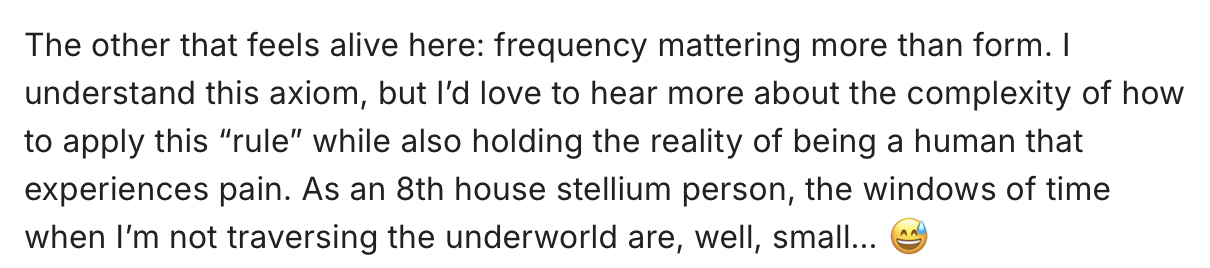
First, I want to deconstruct what (I think) you're implying.
Frequency matters more than form + you being a traverser of the underworld means = your energy 'doesn't feel good' and therefore has some sort of negative effect on your work.
Here's why this isn't true:
If most of the conversation is subtle, and that's what people are picking up on, then what matters is honesty. Or, engaging yourself and Life as you find them.
Forcing positivity doesn't work; rushing your process doesn't work; and pretending you're anything other than what you are doesn't work.
So, if you're experiencing pain, engage it. If you're in a season of living in the underworld, occupy it. If you radiate depth, create space for it.
The big fat lie is that who you are isn't okay, and to run a successful business you need to change it.
Who you are is the business. The way you work is what makes it work.
Now, onto the 8th house stellium (which I feel mildly qualified to get on my soapbox about because I have a 12th house stellium, 8th house Moon, and four planets in a near exact-sextile with Pluto).
Life hands you more raw (often painful) material than most. You can either become a victim of that (ask me how I know), or decide it's your superpower.
Here's some of what sets you apart:
The space you create for others is a byproduct of how deep you've gone with yourself. In other words, people will transform around you, without you doing anything other than being there.
You likely have a confronting energy. Not because you're trying to; just because you are. This is great news; it means you can let go of being widely beloved and get down to business supporting the ones who enjoy being confronted.
Your underworld periods aren't just for you; they're for your work. Your genius ideas, next set of instructions, and felt power—all emerge from this place. Yes, they're hard. And pressure creates diamonds.